

Raising Digital Thinkers: Why AI Literacy Matters More Than Ever Redea Institute calls on parents to better understand the opportunities and risks of AI


As technology advances at unprecedented speed, Artificial Intelligence (AI) has woven itself into everyday life—from phone navigation systems to social media recommendations. Like every major leap in innovation, AI brings tremendous possibilities alongside significant challenges: from diminished critical thinking to algorithmic bias, from accelerated learning to the spread of misinformation. In this landscape, education becomes essential—not to restrict technology, but to equip children with the critical, ethical, and human-centered skills they need to navigate it.
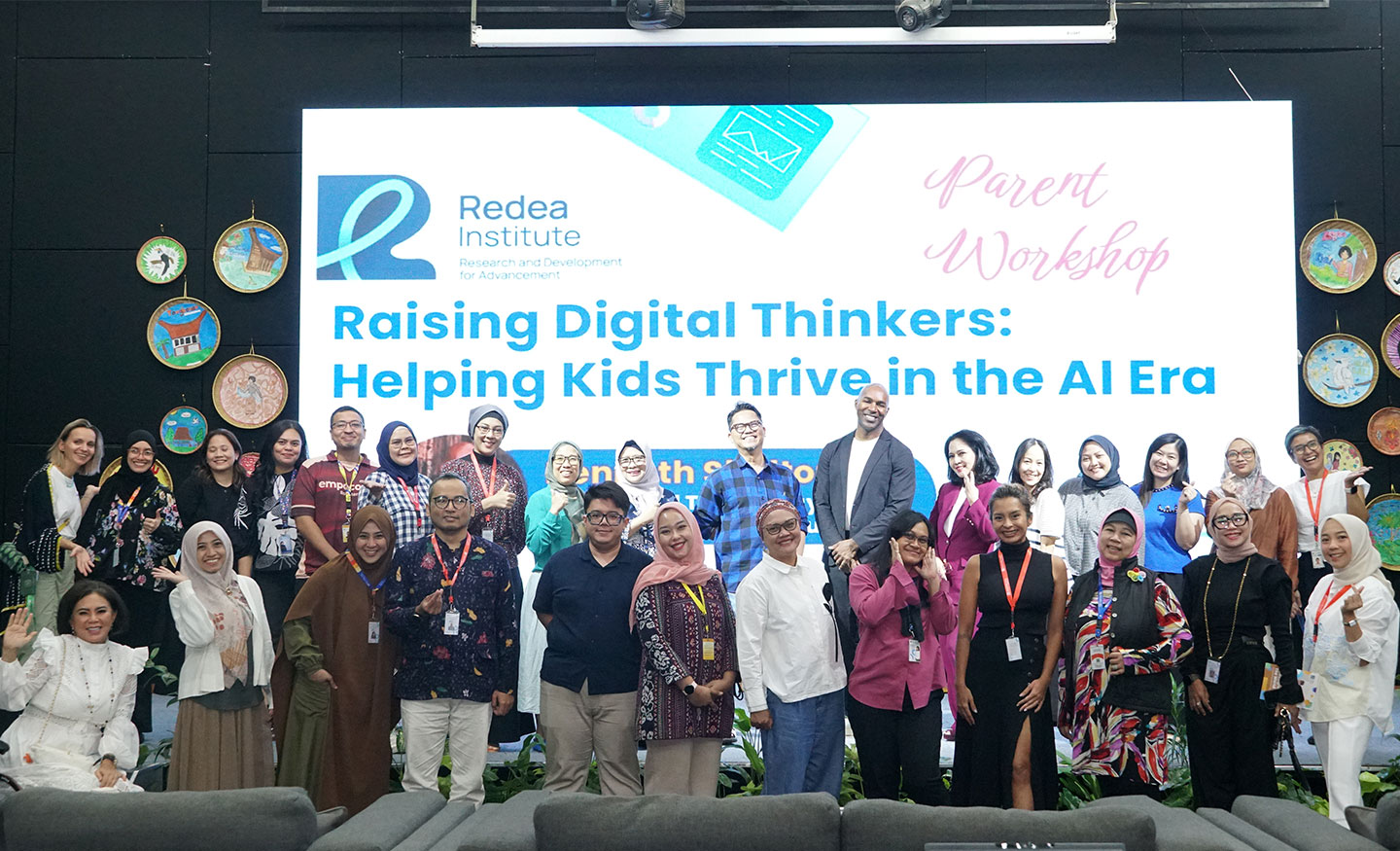
The Research & Development for Advancement (Redea) Institute, which oversees the HighScope Indonesia Institute, hosted a Parent Workshop titled “Raising Digital Thinkers: Helping Children Thrive in the Age of AI” on Tuesday, 18 November 2025. The event featured Ken Shelton, a U.S.-based educational technology expert with more than two decades of experience, author of The Promises and Perils of AI in Education, and recipient of several awards including the Digital Equity PLN Excellence Award and the CUE Platinum Disc Award.
Shelton underscored that today’s children are growing up at a time when AI is already ubiquitous—from chatbots to personalized digital tools—and will soon coexist with technologies far more advanced than those of today. “The AI we have now is the worst AI we will ever see,” he said, urging parents and educators to treat AI literacy as a core competency, much like reading, writing, and numeracy. “AI should not stand in the way of learning. Instead, it should guide students to ask more incisive questions and to deepen their understanding.”
As AI becomes ever more integrated into society, strong collaboration between schools and families is increasingly crucial. Early AI literacy, the Redea Institute emphasized, is no longer optional. It is essential to ensure children grow into not just users of technology, but digital thinkers—capable of analyzing, creating, and making wise decisions in a technology-saturated world.
In the workshop’s opening remarks, the Redea Institute reiterated that AI literacy supports one of education’s key goals: shaping future leaders with strong self-regulation and forward-looking perspectives.
The team also presented Redea’s AI literacy framework, which is integrated into long-term learner outcomes from Early Childhood Education through High School. The framework goes beyond teaching children how to use AI; it helps them understand, evaluate, and take responsibility for their technological choices. AI literacy, as defined by Redea, involves understanding, assessing, and using AI responsibly so that tools like ChatGPT and Gemini enhance learning rather than hinder it. The school employs a staged approach: beginning with consumption (such as using Siri or Bee-Bots), moving to creation (coding and problem-solving), and eventually invention—encouraging students to develop new technological solutions. A similar model is offered to parents through digital literacy workshops, including sessions with psychologists on emotional well-being in the digital age.
To help parents better understand algorithmic bias, Shelton invited them to experiment directly with AI tools as the Redea team demonstrated how large language models (LLMs) can produce responses shaped by geopolitical or social bias. “AI is not the authority of truth. We are,” Shelton noted. “Our responsibility is to question, verify, and teach our children to do the same.” He added, “Today’s students will never know a world without AI.”
Parents participating onsite and online shared a range of hopes and concerns about the role of AI in their children’s lives. Many saw AI as a tool that could strengthen thinking skills, support productivity, and help students learn more efficiently—so long as it does not replace human reasoning. Others voiced concerns about dependency, academic dishonesty, and misinformation. Redea highlighted that one key responsibility of educational institutions is to develop students’ ability to ask the right questions and verify information so they can distinguish facts from hoaxes amid an overwhelming digital information landscape.
Responding to these concerns, the Redea Institute emphasized that thinking skills, ethics, and character must serve as the foundation for any use of technology. From Redea’s perspective, AI literacy is as much about empathy, responsibility, and awareness of consequences as it is about technical skill. During the event, Shelton also met with middle and high school students to discuss their views on current challenges and the AI-shaped future ahead of them—highlighting the value of intergenerational dialogue in preparing students for a rapidly changing world.
Beyond the parent session, Shelton led a series of professional development workshops for teachers from Early Childhood through High School at Sekolah HighScope Indonesia TB Simatupang, as well as educators from affiliated schools at the Elementary, Middle, High School, and Vocational levels. This marks his continued partnership with Redea, following his participation in the 2024 Redea International Conference and subsequent training sessions earlier this year.
The active involvement of educators is central to ensuring that AI literacy is consistently embedded in classroom practice. Antarina S.F. Amir, Founder and CEO of the Redea Institute, expressed her appreciation to parents and teachers who joined the workshop. “This is the moment to rethink the role of AI in education—and how we prepare our children to become digital thinkers ready for the future’s challenges.”
